BEZIEHUNG

im Künstler
im Museum
Junge Frau mit Ibis
1860–1862
New York, Metropolitan Museum of Art (Met), Saal 815 (Inventar-Nr. 2008.277)
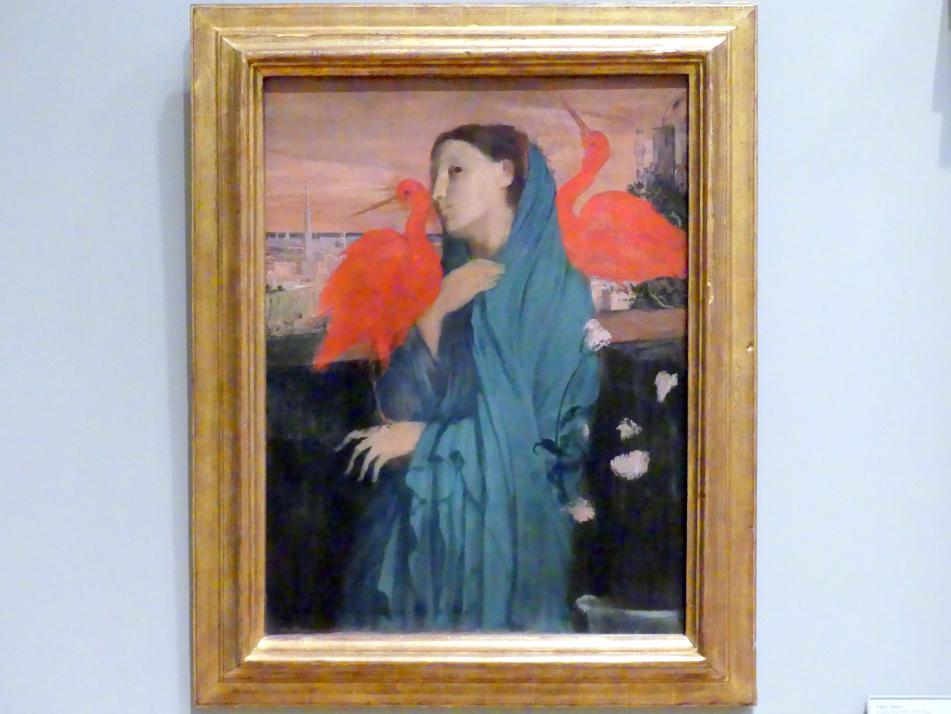
Degas fertigte Skizzen dieser Komposition in einem Notizbuch an, das er während seines zweiten Aufenthalts in Rom in den Jahren 1857–58 verwendete. Ursprünglich als Darstellung einer nachdenklichen Frau konzipiert, erhielt das Bild eine geheimnisvolle Atmosphäre, als Degas um 1860–62 das imaginäre Stadtbild des Nahen Ostens, die rosa Blumen und die beiden roten Ibisse hinzufügte. Etwa zur gleichen Zeit erwog er auch, die brillanten Vögel zu seinem großen historischen Gemälde Semiramis Building Babylon (Musée d'Orsay, Paris) hinzuzufügen.
Degas made sketches of this composition in a notebook he used during his second stay in Rome in 1857-58. Originally conceived as a depiction of a pensive woman, the picture assumed a mysterious air when Degas added the imaginary Middle Eastern cityscape, the pink flowers, and the two red ibises around 1860-62. About the same time he also considered adding the brilliant birds to his large historical painting Semiramis Building Babylon (Musée d'Orsay, Paris).